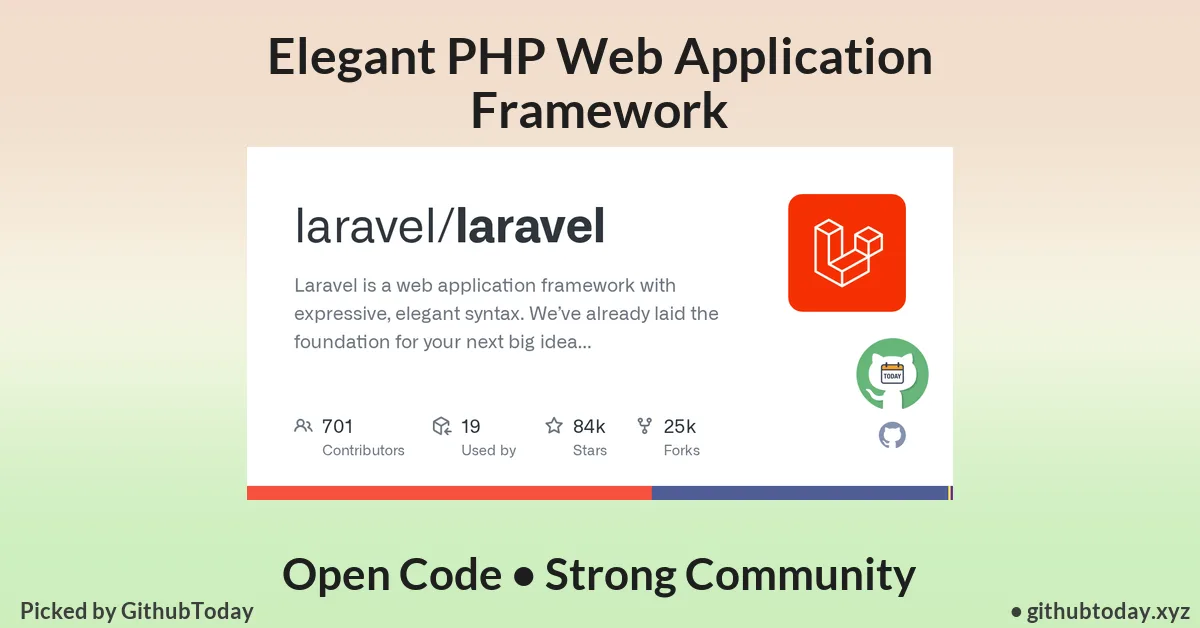
laravel
laravel/laravelIntroduction
Building modern web applications in raw PHP can quickly become complex. Managing routing, dependency injection, database abstraction, background jobs, and real-time features often requires stitching together multiple libraries.
This is where Laravel Framework stands out.
Recognized as one of the most influential PHP ecosystems, Laravel Framework GitHub continues to set the standard for developer experience, architectural clarity, and scalable backend engineering.
For startups, SaaS founders, and enterprise teams alike, Laravel simplifies application development without sacrificing flexibility or performance.
What is Laravel Framework?
Laravel Framework is a full-stack web application framework written in PHP. It provides a structured, opinionated foundation for building web applications and APIs using modern software engineering principles.
At its core, Laravel focuses on:
Clean and expressive syntax
Modular architecture
Built-in tools for common web development tasks
Developer productivity and maintainability
Unlike minimal PHP micro-frameworks, Laravel offers an integrated ecosystem — from routing and ORM to job queues and real-time broadcasting.
On Laravel Framework GitHub, the repository demonstrates a mature, actively maintained project trusted by thousands of developers globally.
Key Features
Laravel’s popularity is driven by its depth and polish. Below are its most impactful capabilities.
Expressive Routing System
Laravel introduces a concise routing layer that maps URLs to controllers in a readable and structured way.
Key benefits:
RESTful route definitions
Middleware support for authentication and filtering
Route model binding
Named routes for maintainability
This reduces boilerplate and improves long-term code clarity.
Powerful Dependency Injection Container
Laravel’s service container resolves class dependencies automatically. This enables:
Interface-driven development
Clean separation of concerns
Highly testable components
Flexible service bindings
For larger systems, this container becomes the backbone of maintainable architecture.
Eloquent ORM
Eloquent is Laravel’s object-relational mapper, designed to simplify database interactions while remaining powerful.
Developers can:
Define model relationships elegantly
Use expressive query builders
Implement eager/lazy loading
Manage data migrations seamlessly
Eloquent strikes a balance between productivity and performance control.
Database Migrations
Schema management is version-controlled through migrations.
Instead of writing raw SQL scripts manually, developers define schema changes in structured PHP classes. This allows:
Team collaboration without schema conflicts
Consistent environment provisioning
CI/CD-friendly database updates
Background Jobs & Queue System
Modern applications require asynchronous processing.
Laravel includes built-in queue support for:
Email dispatch
Report generation
File processing
Notification systems
With retry handling and multiple driver support, it is production-ready.
Real-Time Event Broadcasting
Laravel integrates event broadcasting capabilities to enable:
Live notifications
Real-time dashboards
Interactive applications
Instead of bolting on real-time infrastructure later, Laravel makes it part of the architectural foundation.
Technical Architecture: How It Works
Laravel follows the Model-View-Controller (MVC) pattern.
Core Architectural Principles
MVC separation of concerns
Service container for dependency resolution
Middleware-based HTTP pipeline
Event-driven architecture
Modular package ecosystem
When a request hits the application:
The router matches it to a route definition.
Middleware processes the request (authentication, rate limiting, etc.).
A controller handles business logic.
Models interact with the database via Eloquent.
A response is returned as JSON or rendered view.
This pipeline ensures clarity and maintainability even as applications scale.
Laravel Framework Installation Guide
If you're looking for a clean Laravel Framework installation guide, here’s the simplified process.
Requirements
PHP (supported version)
Composer
A database system (MySQL, PostgreSQL, etc.)
Installation Steps
Install Composer if not already installed.
Run:
composer create-project laravel/laravel project-name
Navigate into the project directory.
Configure your.envfile (database, app key, etc.).Generate application key:
php artisan key:generateStart development server:
php artisan serve
This straightforward process is one reason Laravel remains the best open source PHP project for rapid development.
Real-World Use Cases
Laravel is not limited to simple websites. It is used in:
SaaS platforms
REST APIs
E-commerce systems
Enterprise dashboards
Content management systems
Multi-tenant applications
Its queue system and caching layers make it suitable for high-traffic systems when architected correctly.
Who Should Use This Project?
Laravel Framework is ideal for:
Backend engineers working in PHP
Startups building MVPs rapidly
Enterprises requiring structured, scalable architecture
Agencies developing multiple client applications
Teams adopting CI/CD workflows
It is especially suitable for teams that prioritize maintainability and long-term sustainability over minimalism.
Advantages & Limitations
Advantages
Developer-friendly syntax
Extensive documentation and ecosystem
Built-in support for queues, events, and caching
Strong testing capabilities
Large community support
Limitations
Heavier footprint compared to micro-frameworks
Overkill for extremely small services
Requires understanding of Laravel conventions
For lightweight APIs or microservices, simpler frameworks may be more appropriate. But for full-scale web systems, Laravel’s structure becomes a strength rather than a constraint.
Why Laravel Framework GitHub Continues to Lead
Laravel Framework GitHub reflects a highly active and professionally maintained repository. Its consistent updates, structured contribution guidelines, and well-defined coding standards demonstrate long-term project maturity.
For decision-makers evaluating frameworks, Laravel offers:
Stability
Scalability
Talent availability
Ecosystem depth
It reduces architectural risk by providing a battle-tested foundation.
Final Verdict
Laravel Framework is more than just another PHP framework. It represents a comprehensive development ecosystem designed to improve productivity without compromising engineering discipline.
From routing and ORM to background processing and event broadcasting, Laravel integrates the components most web applications eventually require.
If you're searching for the best open source PHP project to build structured, scalable applications — Laravel deserves serious consideration.
Explore the Repository
Interested in learning more?
Visit Laravel Framework GitHub to review the source code, documentation, and community discussions. Whether you're evaluating frameworks or planning your next application architecture, Laravel provides a mature, reliable foundation worth exploring.